monitoring
Icinga
Open-source monitoring platform for hosts, services and network infrastructure, forked from Nagios.
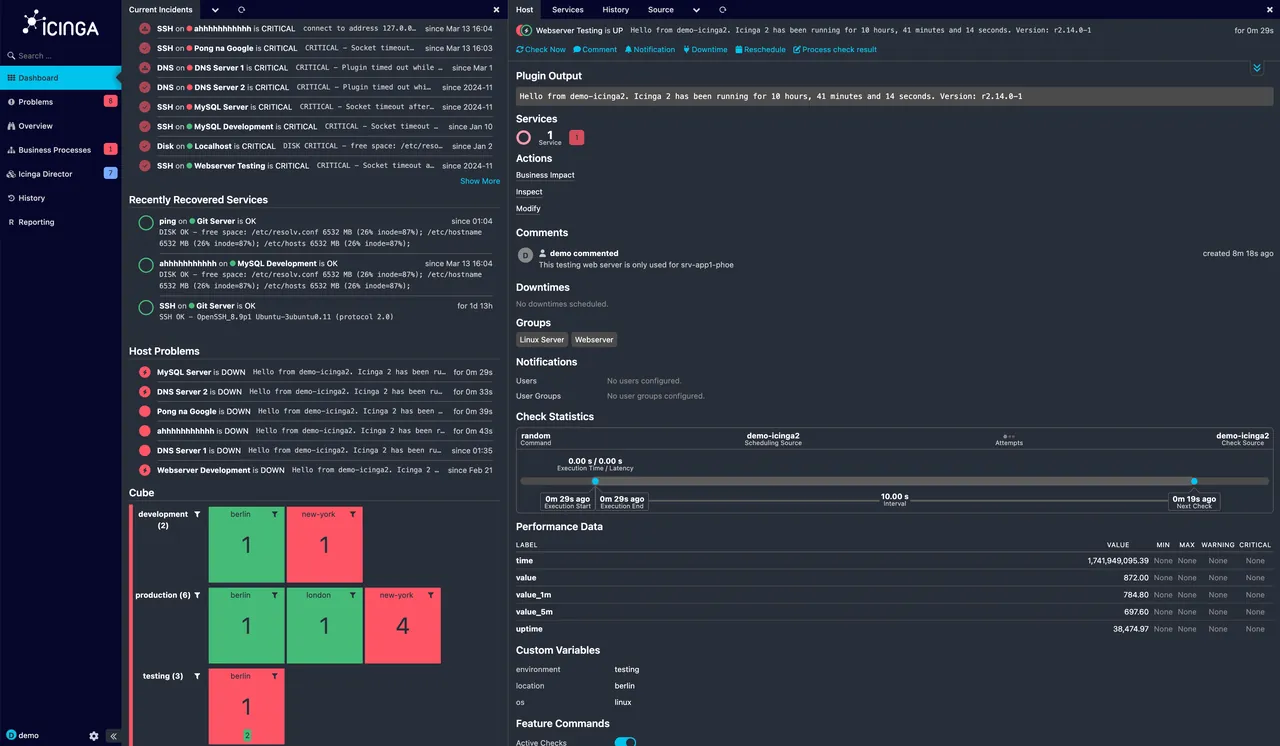
Overview
Icinga is a monitoring platform developed by Icinga GmbH, originally created as a fork of Nagios and since developed into an independent project with its own architecture and components. It is designed to monitor hosts, services, and broader network infrastructure, alerting administrators to problems and providing tools for reporting on availability and performance over time. Icinga is a trademark of Icinga GmbH.
Key capabilities
The core of the platform is Icinga 2, the monitoring engine responsible for scheduling checks, evaluating results, and triggering notifications. Around this core, Icinga provides Icinga Web, a web-based interface for viewing monitoring status, managing configuration, and navigating alerts, along with the Director module, which offers a graphical way to configure hosts, services, and monitoring objects instead of editing configuration files directly. Icinga DB is the data layer used to store and query monitoring state and history, feeding information to Icinga Web and other components.
Because Icinga originated as a Nagios fork, it retains compatibility with many existing Nagios plugins, allowing organizations with prior Nagios plugin investments, or those drawing on the wider Nagios plugin ecosystem, to reuse that work within Icinga. The platform includes alerting with configurable notification methods and escalation logic, as well as reporting capabilities for reviewing historical availability and performance trends across monitored hosts and services.
Typical use cases
Icinga is used by IT and network operations teams that need a monitoring platform combining a modern web interface and modular architecture with compatibility for the established Nagios plugin ecosystem. It is a common choice for organizations that previously used Nagios and want a more actively developed platform with graphical configuration tools like the Director module, without discarding existing plugin-based checks. Typical deployments monitor server infrastructure, network devices, and services, with Icinga Web serving as the primary dashboard for operations staff to track status and respond to alerts.
Licensing and pricing
Icinga is released as open-source software under the GNU General Public License version 2 (GPLv2), making the core platform free to download, install, and use. Icinga GmbH also offers commercial support and subscription options for organizations that want vendor-backed assistance, additional services, or enterprise-oriented support agreements. These commercial offerings are separate from the free, open-source core, and pricing for any subscription or support plan is not fixed or publicly standardized in a single figure, so organizations should consult Icinga GmbH’s official website for current details.
Platform support
Icinga is designed to run on Linux, with the Icinga 2 core engine, Icinga Web interface, and Icinga DB data layer typically deployed together on a Linux-based server stack alongside a supported database backend. As with its Nagios-derived architecture, Icinga monitors a wide range of target systems and network devices through checks and compatible plugins, independent of the operating system running on the monitored endpoints.
Getting started
Icinga is obtained from Icinga GmbH’s official website and official package repositories; this catalog does not host installers or distribute the software directly. A typical deployment involves installing the Icinga 2 core on a Linux server, setting up Icinga Web for the administrative and monitoring interface, configuring Icinga DB as the data backend, and optionally installing the Director module for graphical configuration management. Organizations migrating from Nagios can generally reuse existing Nagios-compatible plugins as part of this setup. For installation guides, documentation, and information on commercial support subscriptions, refer to Icinga’s official site at https://icinga.com.
Where to download
Downloads are hosted by Icinga GmbH on their official website. The button below opens that site — we never host installers.
same segment
Alternatives in Monitoring
All-in-one infrastructure monitoring with sensor-based licensing and a free tier.
by PaesslerOpen-source enterprise monitoring for networks, servers, cloud and applications.
by ZabbixLong-standing open-source monitoring engine for hosts, services and network devices.
by Nagios Enterprises