monitoring
Nagios Core
Long-standing open-source monitoring engine for hosts, services and network devices.
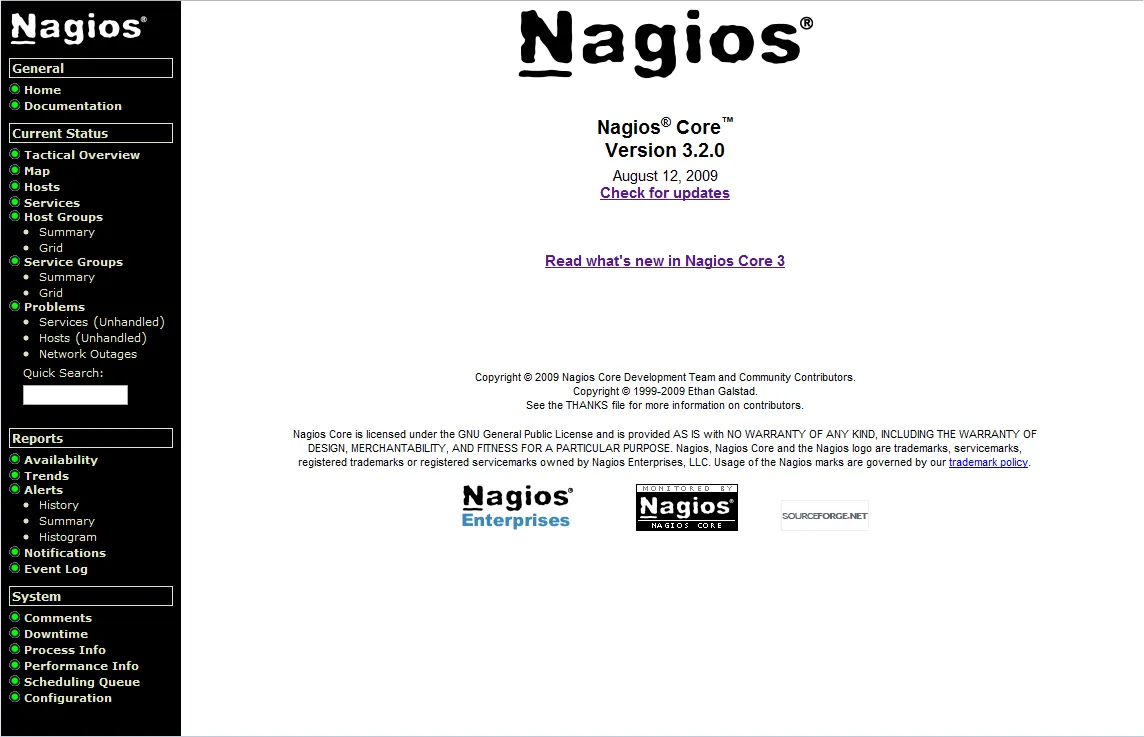
Overview
Nagios Core is a host and service monitoring engine developed and maintained by Nagios Enterprises. It is one of the longer-established open-source monitoring tools and forms the underlying engine that a number of other monitoring projects and commercial products have built upon. Nagios Core focuses on checking the status of hosts and services and alerting administrators when problems are detected. Nagios is a trademark of Nagios Enterprises, LLC.
Key capabilities
At its core, Nagios Core is a monitoring engine built around a plugin architecture: rather than embedding every possible check directly into the core application, Nagios executes external plugins that perform the actual check logic and return a status back to the engine. This design keeps the core lightweight while allowing monitoring coverage to be extended to virtually any system, service, or metric for which a plugin exists or can be written. Plugins follow a defined interface, so custom checks can be created in common scripting languages.
Beyond running checks, Nagios Core provides scheduling for recurring checks, state tracking for hosts and services, and a notification system that can alert administrators through configurable methods, with support for escalation paths when problems are not acknowledged within a defined time. A significant part of Nagios Core’s practical value comes from its plugin and community ecosystem: Nagios Exchange hosts a large collection of community-contributed plugins, configuration templates, and add-ons covering many operating systems, network devices, and applications, reducing the need to write custom checks from scratch.
Typical use cases
Nagios Core is typically used by system administrators and IT operations teams to monitor the up/down status and key health indicators of servers, network devices, and services, triggering alerts when a host becomes unreachable or a monitored service fails a check. It is often chosen for its maturity, its plugin-driven flexibility, and its large body of existing community plugins, which makes it adaptable to environments with varied and sometimes unusual monitoring requirements. Organizations that want a lightweight core engine and prefer to assemble their own monitoring stack from plugins and add-ons, rather than adopting an all-in-one platform, frequently use Nagios Core as that base layer.
Licensing and pricing
Nagios Core is released as open-source software under the GNU General Public License version 2 (GPLv2), so it can be downloaded, installed, and used without license fees. Nagios Enterprises also develops Nagios XI, a separate commercial product that builds on the Nagios Core engine and adds a graphical web interface, configuration wizards, and additional features beyond what Core provides out of the box. Nagios XI is licensed and priced separately from Nagios Core; organizations interested in it should consult Nagios Enterprises’ official website for current licensing and pricing details, since Nagios Core itself remains free.
Platform support
Nagios Core is designed to run on Linux. Deployment typically involves installing the core engine, a web server to serve the built-in web interface, and the desired set of plugins on a Linux host. Because Nagios relies on external plugins to perform checks, the range of systems it can monitor extends well beyond Linux itself, covering network equipment, Windows systems (via appropriate plugins and agents), and other platforms, provided a suitable plugin is installed and configured.
Getting started
Nagios Core is obtained from Nagios Enterprises’ official website, where source packages and installation documentation are published; this catalog does not host installers or distribute the software. Community plugins are separately available through Nagios Exchange. Getting started typically involves installing Nagios Core and its dependencies on a Linux system, configuring host and service definitions, selecting or installing the plugins needed for the environment, and setting up notification methods for alerts. Administrators evaluating whether to use Nagios Core directly or the commercial Nagios XI product should review both options on the vendor’s site before deciding. Further details are available at https://www.nagios.org.
Where to download
Downloads are hosted by Nagios Enterprises on their official website. The button below opens that site — we never host installers.
same segment
Alternatives in Monitoring
All-in-one infrastructure monitoring with sensor-based licensing and a free tier.
by PaesslerOpen-source enterprise monitoring for networks, servers, cloud and applications.
by ZabbixNetwork and server monitoring with fault management and reporting.
by Zoho / ManageEngine